Websites and continuity
Your website doesn't stream football.It can still suffer from the blocks.
A customer opens your website and it won't load. It works on another connection. The server is running, but the internet provider is blocking a shared IP address. For a business, the result is a missed enquiry or sale.
How a legitimate website gets blocked
During football broadcasts in Spain, internet providers block IP addresses at LaLiga's request to prevent access to unauthorised streams. One IP can be the entry to many different websites, particularly on a distribution network such as Cloudflare. The block also affects businesses with no connection to those streams.
That explains why a website might work over mobile data but fail on a fibre connection, or stop loading only during certain matches. The problem need not be its design, its hosting or the visitor's device.
Other countries use this type of blocking too. In Italy, Piracy Shield allows domains and IP addresses to be blocked and has recorded mistakes including a block affecting Google Drive. The legal context differs, but unrelated services can still be affected.
My position is clear
I strongly oppose the indiscriminate blocking of websites driven by the football lobby. Protecting broadcast rights does not justify cutting off access to businesses, professionals and services unrelated to a broadcast.
Someone visiting a website to enquire about a service should not need technical knowledge, a VPN or a different internet provider. Continuity should be handled by the website's infrastructure.
An alternative entry, the same website
This website keeps Cloudflare as its usual entry and has an alternative entry on Netlify for periods of blocking. We change the access route while keeping arturpuig.com and every page's address. Visitors are not sent to another domain or a waiting page.
The alternative entry retrieves the current website content and keeps a copy to serve the pages if the origin does not respond. The contact form and assistant communicate with the original service through a protected channel; their credentials are not placed in the browser.
When we use that route, a visible notice explains the situation and links to this guide.
| Usual access | Continuity mode | |
|---|---|---|
| Address | arturpuig.com | arturpuig.com |
| Entry | Cloudflare | Netlify |
| Pages | Current content | Current content, with a backup copy |
| Visitor | Opens the website | Opens the same website, without configuring anything |
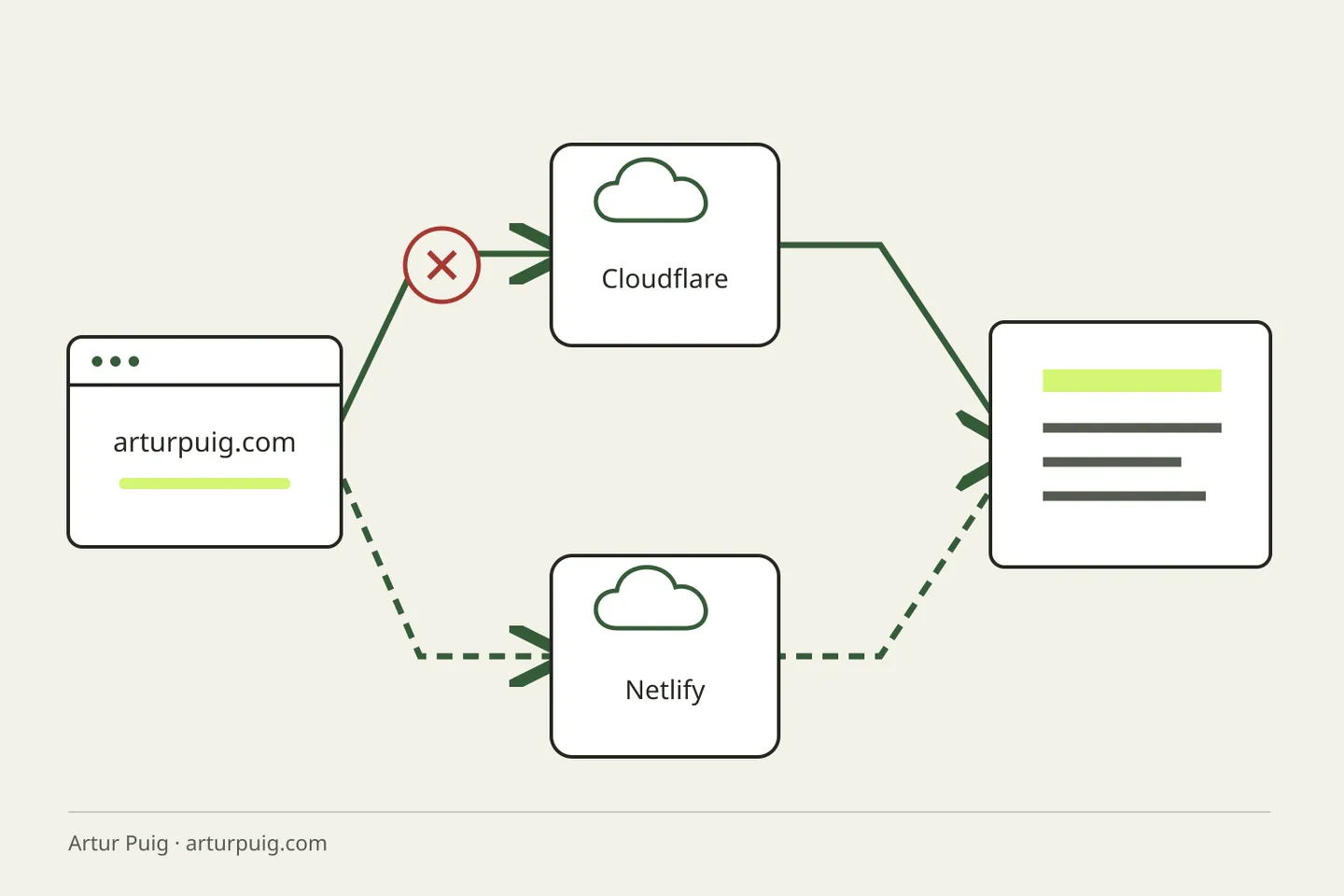
When access switches
The system checks access from several Spanish internet providers. If the usual entry fails repeatedly and the alternative responds, it automatically switches to Netlify. Returning to Cloudflare is automatic too, after checks show that access has remained stable. The switch follows conditions set in advance; a single measurement does not trigger it.
This runs in the cloud. The website keeps HTTPS on both its usual and alternative access routes.
What this means for customers and search engines
You can keep browsing the same address and using the same links. Languages, canonical addresses and the files that help search engines discover pages are preserved. Switching the entry does not add a chain of redirects to reach the content.
This reduces the risk of losing visits through a blocked entry. It is not a promise of Google rankings or uninterrupted access: another IP could be blocked, the alternative network could have an outage, and the backup copy reflects its last publication. DNS changes can also take time to reach every connection.
What to plan for your business website
Continuity needs to cover more than the home page. Forms, security, languages, links, assets and error pages must work too. There also needs to be a clear way back to the usual service.
If your website depends on enquiries, bookings or sales, these decisions belong in its maintenance plan. The right option depends on traffic and the services it uses; free plans have limits and do not replace a contractual availability guarantee.
Sources and further reading
Questions before we start
Do I need to change anything to visit this website?
No. Use arturpuig.com and your usual links. The entry changes in the website's infrastructure, without asking you to use a VPN or adjust your device.
Could the alternative entry be blocked too?
Yes. No provider or particular IP address guarantees immunity to blocking. Another entry reduces dependence on a single network, but does not eliminate every possible failure.
Does switching the entry mean changing the domain?
No. The domain and page addresses stay the same. What changes is the service receiving the visitor's connection.